


One of the worst-kept secrets among market watchers is that the stock market has historically done well after midterm elections. It’s not about who won, but rather clarity on the policy landscape.
A Seasonal Boost
Across all years, November through January has historically been the best three-month period of the year, with an average S&P 500 gain of 4.4% and gains 74% of the time.
Midterm years are stronger still. Since 1970, the S&P 500 has averaged a 14.1% gain in the six months immediately after the election. Over the subsequent 12 months following a midterm, it has been higher 19 straight times back to 1950. And a step further, in 21 of the last 22 midterm election cycles, the market has posted a positive return since 1938; an impressive batting average.
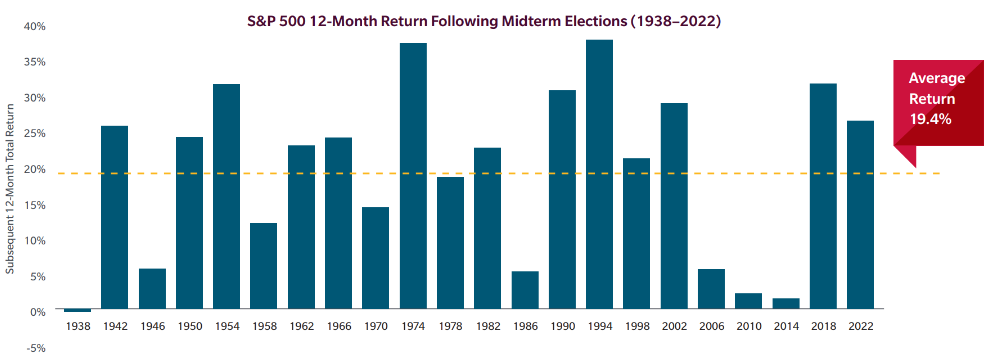
Source: Morningstar, FactSet. Annual data from 1938 to 2022. Data from 1938 to 1970 represented by Ibbotson Associates US Large Stock Total Return Index, data from 1971 to present represented by S&P 500 Total Return Index.
Returns are gross and in USD. Past performance is no guarantee of future results.
What Causes This?
Clarity is at the core of it: markets hate uncertainty. Before a midterm, investors can’t know who will control Congress, so some sit on cash. Once results are in, that money tends to come back quickly, regardless of which party wins.
Gridlock helps too. The president’s party usually loses seats in midterms, and a divided Washington makes sweeping policy surprises less likely. Finally, the year after a midterm is the third year of a presidential term, historically the strongest of the four-year cycle.
This year already broke the script. Instead of the usual midterm slump, U.S. stocks were up 10.5%, January through October; the sixth-best midterm-year start since 1926. With less of a dip to recover from, a post-election boost could be smaller than anticipated.
What Does It Mean?
Nineteen data points is a small sample, and correlation isn’t causation. Recessions, Fed policy, and earnings, among other things, will matter far more than the electoral map.
The real lesson of the midterm effect isn’t to time the market around elections because this is simply a historical pattern, not a promise for the future. Political anxiety isn’t typically a good reason to abandon a long-term plan. At the margins, a changing political landscape may influence sector performance, but rather than positioning around the political outcome, confirm your portfolio aligns with long-term goals.
Andrew Rabon, CPFA®
864.765.0374
Securities offered through LPL Financial, Member FINRA/SIPC. Content provided here reflects personal views and has not been reviewed by LPL Financial for accuracy or completeness. The information provided is for informational purposes only, may not be suitable for all investors, and does not constitute personalized financial, tax, investment, or legal advice. Past performance is no guarantee of future results; all investments involve a degree of risk, including the risk of loss.