
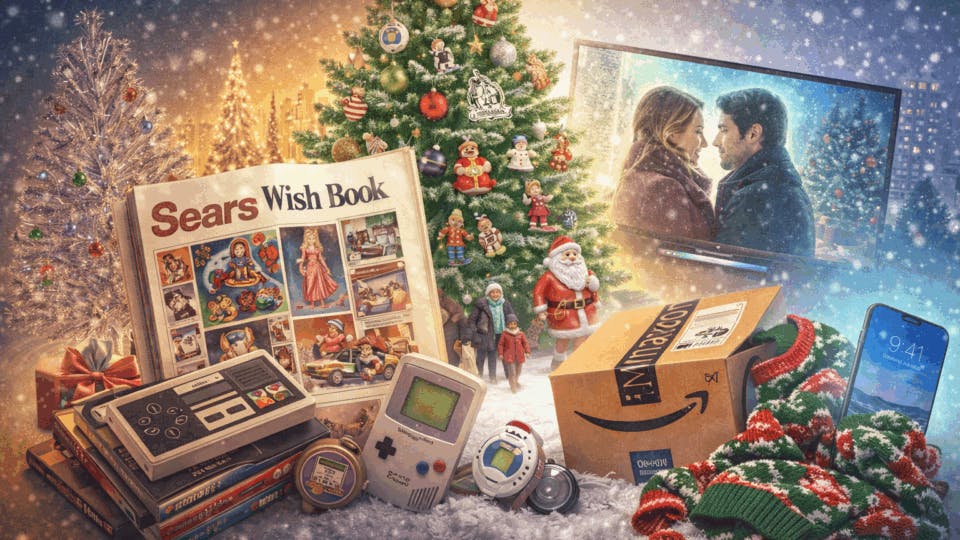

In my 50 years of life, the Christmas season has changed — not only for me personally, but in society as a whole. What was once a tradition-focused, family- and community-oriented season has slowly shifted into something more secular and convenience-driven.
Here are my memories of Christmas over the past five decades — the trends, the trees, and the gifts.
1970s: Nostalgia and Homemade Charm
The Christmas season never started until after Thanksgiving.
Christmas shopping meant flipping through a physical catalog — usually the Sears Wish Book — or getting in the car (or on a bus) to visit local brick-and-mortar stores like Kmart or Sears. Sometimes we piled into the car and headed to the local mall — for me, the Dayton Mall — to shop, eat, and visit Santa.
Homemade gifts were common (what we now call “DIY”), even though there was no YouTube to show us how to make them.
Aluminum (silver) Christmas trees were popular, with a rotating multicolored light reflecting different colors off the branches. Classic Christmas TV specials like A Charlie Brown Christmas, Frosty the Snowman, and Rudolph the Red-Nosed Reindeer were must-see television.


1980s: The Rise of Sparkle and Big Decorations
The Christmas season still didn’t begin until after Thanksgiving.
Living in Ohio at the time, I remember people wearing thick, sparkly sweaters — the early versions of today’s “ugly Christmas sweaters.” Outdoor decorations became more popular, usually meaning lights outlining houses or bushes.
Tree trends shifted back to green trees, decorated with lots of glitter, tinsel, and bright colors. Hallmark Keepsake Ornaments became must-have collectibles, sold at your local Hallmark store.
This decade also marked the beginning of life-size outdoor plastic Santas and snowmen glowing in front yards everywhere.
1990s: Malls, Flannel, and Movie Blockbusters
Once again, Christmas didn’t start until after Thanksgiving.
Most shopping was still done in physical stores, and the mall was the place to be. Stores like KB Toys, Sam Goody, RadioShack, and Spencer Gifts were packed. Walking into a mall meant crowds, cinnamon pretzels, holiday music, sparkling lights, and people spending money.
Popular gifts for kids included:
- Tamagotchis (Google it)
- Tickle Me Elmo
- Nintendo Game Boy
- Pogs
Other trends included Beanie Babies, the Sony Walkman, flannel clothing, and movies on VHS tapes.
Christmas movies of the 1990s included:
The Santa Clause with Tim Allen
It’s a Wonderful Life
Home Alone
Planes, Trains & Automobiles
National Lampoon’s Christmas Vacation

2000s to Today: A Digital and Secular Shift
Today, Christmas seems to start as early as September.
The season is largely defined by convenience and has become mostly secular. Shopping is now dominated by online retailers — especially Amazon — which has replaced the printed catalog with a digital one. Package deliveries, once a rare treat, are now an everyday occurrence.
A recent Friday night trip to the local mall in December felt quiet and subdued. The food court was the most crowded area.
New traditions have emerged:
- Elf on the Shelf
- Ugly Christmas sweater parties at work and church
- Streaming services that let us watch anything, anytime
- Hallmark Christmas movies replacing Hallmark Christmas ornaments as the seasonal obsession
What Christmas Still Means to Me
In the midst of all these changes, my idea of Christmas remains simple.
God was born into this world in the form of a child — hence the name Christ-mas.
As we exchange gifts in His name, let’s remember that He has already given us so much:
- The sun, moon, and stars
- The earth, forests, mountains, and oceans
- Every living thing
- All that grows, blooms, and bears fruit — even the things we misuse or argue over
And to rescue us from our mistakes and our sins, He came to earth and gave us Himself.
Merry Christmas
