


Many people put off investing because they are afraid of buying at the wrong time. They worry the market will drop the moment they get in. So they wait. And while they wait, their money sits in cash doing very little.
But what if you invested at the worst possible time, every single year?
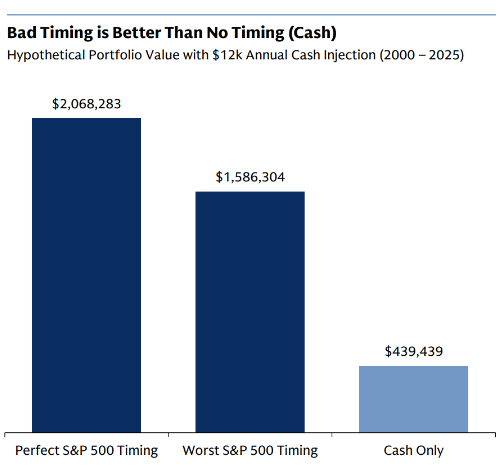
The chart below follows three hypothetical investors from 2000 to 2025. Each one invests $12,000 a year. One buys into the stock market on the lowest day of every year (“Perfect Timing”). One buys on the highest day of every year (“Worst Timing”). The third never invests and keeps everything in cash (“Cash Only”, 3-month US Treasury Bill).
What does this mean?
Notice the investor with the worst timing. After buying at the peak every year for over two decades, they still ended up with about $1.59 million on $312,000 invested. The investor who stayed in cash finished with about $439,000 on the same $312,000.
The worst timing possible still beat cash by more than three and a half times.
The point is timing matters far less than most people think. This chart includes significant downturns within its tenure, such as the dot-com crash, 2008 financial crisis, 2020 pandemic, 2022 downturn, and others. Even the investor with the worst timing lived through every one of them and still came out far ahead of their original investment. Getting invested and staying invested matters much more. Money in the market has time to recover from downturns and compound over the years. Money sitting in cash does not.
Takeaway
Some of you may still look at that chart and only see the Perfect Timing bar and think “Forget the worst timing, perfect timing will be me!” You’ve missed it completely. Perfect Timing and Worst Timing are the goalposts, and most investors will likely land somewhere in between. Ending up at either extreme is possible, but not probable. There is no such thing as a perfect investor.
Investing is not about chasing the highest return possible. It is about reaching something that matters to you. That might be retiring at a certain age, paying for a child’s education, buying a home, or leaving something behind for your family. Each goal comes with its own timeline and its own level of risk that makes sense.
This is where a financial advisor can help. An advisor works with you to define what you are actually investing for. From there, they can build a plan that fits your goals, your timeline, and your comfort with risk. They can also help you stay on track when the market gets rough, and the urge to pull out feels strongest. Often, that steady guidance is what keeps a plan working.
The chart shows that waiting for the perfect moment is not the answer. The better question is not “When should I invest?” but “What am I investing for?” Once you know that, a clear plan can help you get there.
Andrew Rabon, Financial Advisor
864.765.0374
Securities offered through LPL Financial, Member FINRA/SIPC. Content provided here reflects personal views and has not been reviewed by LPL Financial for accuracy or completeness. The information provided is for informational purposes only, may not be suitable for all investors, and does not constitute personalized financial, tax, investment, or legal advice. All investments involve a degree of risk, including the risk of loss.