
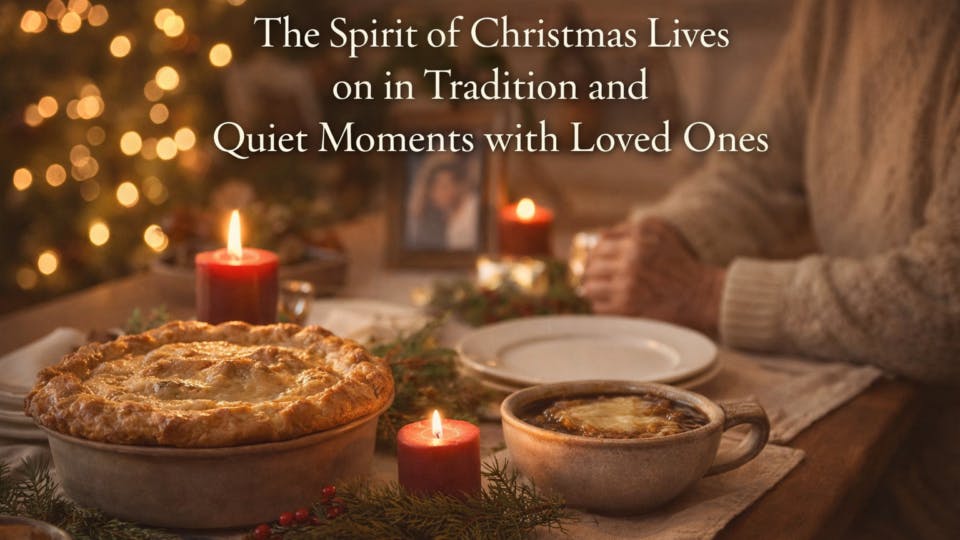

For me, the spirit of Christmas has always arrived quietly—not with the sound of presents being unwrapped, but with the familiar smells coming from the kitchen on Christmas Eve.
Long before the tree lights were plugged in or the first carol played, Christmas announced itself through food, tradition, and the presence of family.
Every year, without fail, my grandmother’s tourtière (French Canadian meat pie) took center stage.
It wasn’t written down in a recipe book—it lived in her hands, her memory, and her heart. She knew exactly how much seasoning was “just right,” when the filling was ready, and how long the crust needed, never once checking a clock.
Watching her cook was like watching a ritual, one passed down not through instructions, but through love. That tourtière wasn’t just a dish; it was history, comfort, and belonging baked into one.
Alongside it, French onion soup simmered slowly on Christmas Eve, filling the house with a rich, savory warmth that felt like a hug the moment you walked through the door.
The onions caramelized patiently, teaching a quiet lesson about slowing down—something Christmas gently asks of us every year.
We would gather around the table, bowls steaming, laughter echoing, stories retold for the hundredth time, and somehow, they always felt new.
These moments shaped my understanding of the spirit of Christmas.
It wasn’t about extravagance or perfection.
It was about showing up, year after year, for the people you love.
It was about traditions that anchored us, even as life changed around us. In those simple meals, I learned that love doesn’t have to be loud—it just has to be consistent.
The spirit of Christmas lives in the details:
- the familiar recipes
- the worn serving dishes
- the way certain foods can bring someone back into the room even if they’re no longer sitting at the table
My grandmother’s presence is still felt every Christmas Eve, lingering in the smell of spices and onions, reminding me that love never truly leaves—it just changes form.
Christmas has a way of softening time.
It invites us to remember where we came from and who helped shape us. It encourages us to pass something meaningful forward, whether that’s a recipe, a story, or simply the act of gathering with intention.
In a world that often moves too fast, these traditions ground us.
As the years go on, I’ve come to understand that the spirit of Christmas isn’t found in a single day.
It’s found in the care we put into creating moments for others, in honoring the past while making room for new memories, and in choosing warmth—both literal and emotional—when the world feels cold.